Why Caput?
word of the month

Zdorovo!
I decided to make this newsletter both to practice some regular English writing and because it seems an exciting way to communicate ideas. I am interested in how technology interacts with social norms and principles, so most of the posts here will be somewhere around science, technology, and society. However, I am also interested in history and the words that make it. Ultimately, every idea is a set of words put in the proper order, so from time to time, we'll revisit a word or a phrase that seems particularly fascinating.
Today we'll start with the name of this substack — caput — a Latin word for "head." You might have heard some echoes of this original Latin word if you like medieval history or fantasy fiction.
In "Decapitate this vampire immediately!" the verb 'de-capit-ate' stands for 'remove the head.' Now that you see the root 'capit,' a less exotic example might come to your mind. Something like "London is the capital of Great Britain." Indeed, there is no surprise that the principal city could be called "the head city" or "the capit-al." I am sure you see where it is going by now, but the next plot twist might surprise you.
The word 'capit-al' as in 'capitalism should be smashed' or 'God, save capitalism' comes from the same ancient root. What does 'head' have to do with the capital, though? Isn't it all about money? Yes, and no1. Before we even invented money, we were already trading. These trades were usually direct exchanges: I give you a dozen apples, you give me a pouch of salt. However, two basic property types were qualitatively different: land and livestock. The land was naturally immobile. Your field got burnt by huns? Bad luck. See you next year; maybe they'll burn some other lot next time. Livestock, on the other hand, moved on its own! If the village is not safe anymore, the herders can move, whereas the landlords stay where they are. The headcount of your cows was your "capital." This uncanny coincidence provokes further thought, especially since people talk about human capital in the twenty-first century. Ironically, human capital stands for how many brilliant 'heads' a society has, and these 'heads' move on their own wherever the intellectual grass is greener.
In this substack, I'll try to discuss the conditions that attract talent, how talent transforms societies and organizations with innovation, and why some transitions fail while others succeed. Welcome to caput! I hope it'll be fun.
P.S. While we are at it, the modern letter 'A' is a bull's head turned on its' horns, dating its' origin back to the Egyptian hieroglyph, which depicted an ox's head. Just another fun 'capital' fact. Have a good weekend.
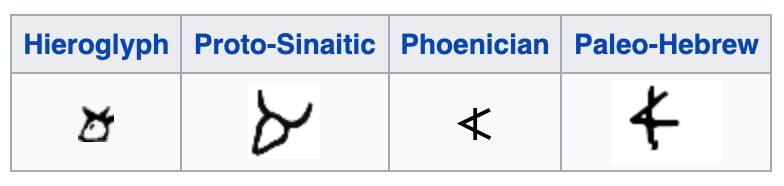
Here is the ‘evolution’ of ‘A’ from Wikipedia.
or 'jain' as they say in German